Week 6 of the One Room Challenge has been a doozy. Things moved slower than I hoped, and I ran into several issues as I was working. But at the same time, some things worked out better than I hoped.
I don’t think the room will be completed at the end of 8 weeks, and I’ve made my peace with that. I’d much rather take more time than try to rush everything and end up fixing things later.
A few pivots
Late this week, I decided I wanted beadboard behind my shelves. My thought was that this would help the built-ins look even more professional, and that they’d be more classic in style. Plus, it’s a nice visual.
I then decided that beadboard should also go on the bench for continuity purposes. Even without the top trim or bench top in place, I’m happy with how it’s looking.
While I started making way on the beadboard for behind the built-ins, my nail gun jammed. It took about half an hour to take it apart and remove the jam. Then I was off and running…for about 2 minutes. And then it jammed. Again.
Took it apart, cleared the jam, then started working again. For another minute. Then it jammed again. I about lost my mind, uttered a few expletives, and jumped on Amazon to see if I could find an inexpensive replacement that could be delivered next day.
For those who travel by floo powder
Since I was unable to do work that required a nail gun, I started working on the fireplace. Let me tell you that if you’re considering building a corner fireplace…don’t. Hire someone or change your plans.
This fireplace is the bane of my existence right now, but if I get what’s in my head (and on my graph paper) into reality, it’ll be good. Are the angles and wood perfect? Nope. Is it level? Yes. How is it level? I couldn’t even tell you.
I’m still not 100% sure how I’m going to finish the fireplace, but I’ll figure it out.
“Diagonalley!”
I love the first time Harry uses floo powder and doesn’t distinctly say, “Diagon Alley!” I also love the first time we see Diagon Alley, and I wanted a nod to that in the room. Enter bricks.
I started getting the bricks on one wall using a peel and stick deal, and they can be painted! You can catch a glimpse of them on my latest Instagram reel.
More to come on that.
Getting ready for Week 7
I promise I’ll take more videos and pictures of progress this week. I was all over the place during week 6, trying to fit tasks in during my lunch hour to pulling out the saw after work to get cuts done before 8pm (in order to be a good neighbor), and I just didn’t feel like dragging my phone around everywhere to capture all of that.
I may have to pivot on the shelves, but I’m still thinking that over. Lots to do this week! If I can get everything built and prepped for paint, then Week 8 will be all paint! Fingers crossed.
Oh, and my Porter Cable nail gun arrived. So far, I love it! I’ll link it up next week if it still has my seal of approval.
I can’t believe we’re already in week 5 of the One Room Challenge! I truly feel so far behind right now, but I’m hoping I’ll get caught up with everything this weekend. Having to remove the popcorn ceiling myself threw a tiny wrench in things, but at least I saved a lot of money!
Let there be light (and more outlets)
This room doesn’t have the best lighting. While it gets great light from morning until mid-afternoon, the lighting setup is quite lacking. There are only 4 recessed lights in this space. And they’re all in a row. And they’re all on one side of the room. That’s it. No light fixture in the middle of the room. Just 4 lights over to one side.
To be fair, several of the outlets are wired to the light switch, so you could use multiple lamps if you wanted. I’m just not a big lamp person (or a little lamp person). The only reason we have lamps is so I can set them on timers for when we’re out of town and make it look like we’re home.
The only lamp I use is the one on my nightstand. And I have it on a smart switch, so I can turn it on and off using Google routines. I love a good Google routine. I’ll have to share more on that in another post.
This past week, I had electricians replace some recessed lights, install additional outlets, new light switches and get ready for a new chandelier to be installed. Unfortunately, the chandelier I’d purchased wasn’t UL certified, so they were unable to install it. That’s what I get for being cheap.
At least they were able to install a temporary light to tide me over until my new chandelier (the one I should’ve just ordered in the first place) arrives in a few days.
So now I have four new recessed lights, additional outlets higher on the wall where my built-ins will go, and overhead lighting in the center of the room.
Here are the links to the lights and smart switches I purchased. Just a heads up that they’re affiliate links. All that means is if you decide to buy using the link I provide, I get a few pennies at no cost to you.
Recessed lights (Heads up: Amazon is offering a lightning deal on these right now)
This week, I decided to tackle the built-in bench for under the window. That proved to be more difficult than I thought. Not only do I have a floor vent to take into consideration, but the corners are not square. I mean, what house has perfectly square corners? Certainly not this one!
To get started, I brought in some 2x4s to lay them out and figure out the cuts I’d need to build the bottom of the bench. I’m not going into detail because this entire bench project has been a cluster. I did have to cut out more carpet, which is terrifying as much as it’s fun.
Don’t worry. I saved the carpet just in case I really messed things up.
All I can say is that I must have purchased my measuring tape from Zonko’s Joke Shop because I’d measure about 3 times (every time) before I’d make a cut, used the same measuring tape by the saw, and my cuts were rarely perfect. Mind you, I didn’t expect perfection, but I did expect to be within a sixteenth of an inch.
I finally got to use my new Kreg jig to make a million pocket holes, and it was amazing. I can hook it up to the shop vac while I drill holes, and I’m left with next to no mess. If you want one for yourself, here‘s the link.
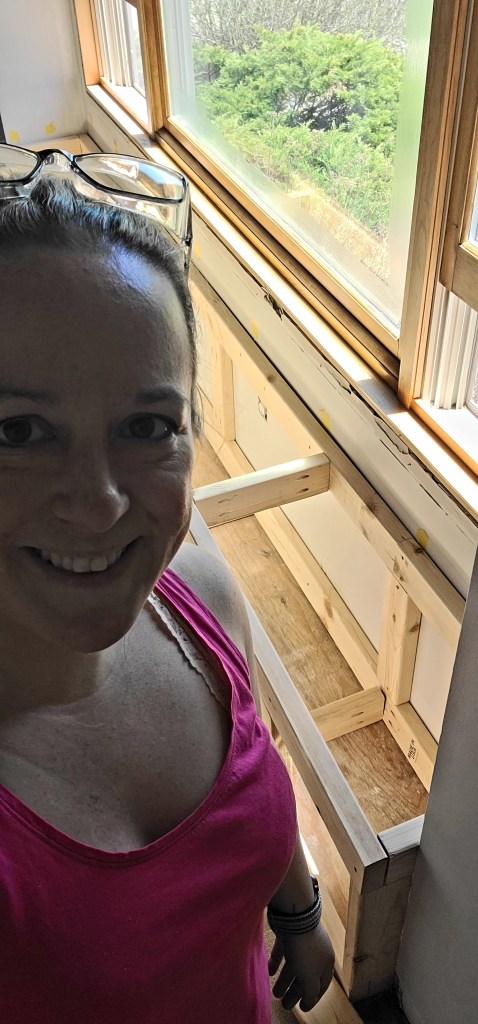
It took me a few nights and a little bit of Saturday morning to finally get the shell of the bench finished. Is it level? Yes. Does it look professional? Not even close. That’s where the finishing work comes in. But I did walk across the bench to make sure it wouldn’t fall apart. In hindsight, I probably should’ve asked for a spotter, but I was fairly confident that I had made the bench pretty well. And I’m pretty sure Blake was still asleep when I had finished up.
Oh yeah, don’t look too closely. Apparently, a couple of my 2x4s were not perfectly straight.
Hey, at least it’s level.
The beginning of the wall of built-ins
While I was on a roll with finally getting the bench started, I decided to tackle the built-in cabinets. This part was actually a tiny bit easier because I only needed a small base for the cabinets. The only problem here is that my new baseboards are 5.5″ tall, and the cabinets sit about 4.5″ above the carpet.
That meant that instead of using 2x4s, I was going to have to find something that was an inch. I did get some 5/4 select pine a couple years ago for a different project that I never completed, so I got to pull out the table saw and rip the 5/4 (because the actual size is 1 inch) down to 1″ boards.
No one lost any appendages. No wood came flying back at my face. I consider that a successful table saw adventure.
With the base, I just screwed the 1″ boards directly into the subfloor. Once that was done, it was time to start loading in the cabinets. But not so fast.
I had a couple obstacles to work around:
Outlets that I still need to access
The pesky floor vent that isn’t centered on the wall
I purchased a Toe Ductor kit (I’ll include the link below) to make my floor vent into a toe-kick (or baseboard) vent. It came with one page of instructions that basically said, “Attach Part A to Part B using the venting tube; attach Part A to floor; attach Part B to toe kick.” It also said to check out their YouTube video for installation instructions, which, honestly, really wasn’t that helpful.
Since the floor vent isn’t centered on the wall, my conundrum is this:
The floor vent kit was going to extend across three cabinets.
Two cabinets have either an outline or a telephone outlet I have to cut holes for.
The vent needed to be centered on the wall, so I would have to cut out part of the base of the center cabinet.
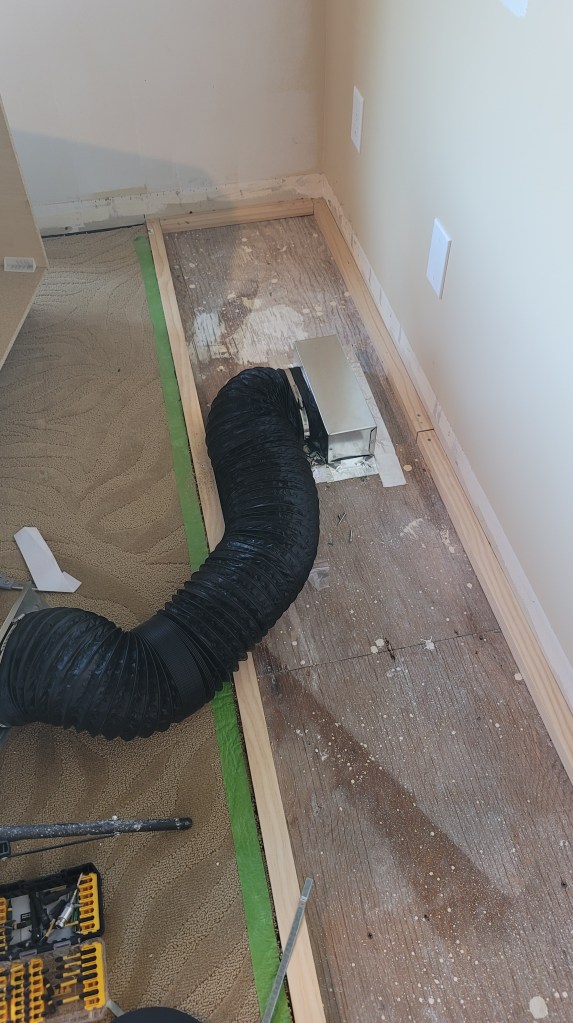
Before I started installing the cabinets, I had to get the floor vent kit set up. I used some water-based duct sealant on the floor surrounding the air vent, as well as on the piece that attaches to the floor. Since I needed to move the air to the middle of the wall, I purchased longer vent tubing (about 8 feet, just to be on the safe side), screwed the piece into the subfloor and surrounded it with a special tape for ducting.
Once the floor vent kit was installed (at least the first part), I was able to cut out a portion of the cabinet that would be sitting over the vent piece. At this point, I had to enlist Blake’s help to move the cabinet over the venting piece. I also had to cut out a piece in the back of the cabinet so I could still have access to the outlet.
On the second piece, I had to cut large rectangles on the left and right sides to allow the vent tubing to fit underneath. I almost didn’t, but I decided to cut a piece for the telephone jack. We don’t have a landline, but hey, you never know.
I saved the middle cabinet for last and focused on getting the other 2 cabinets in place.
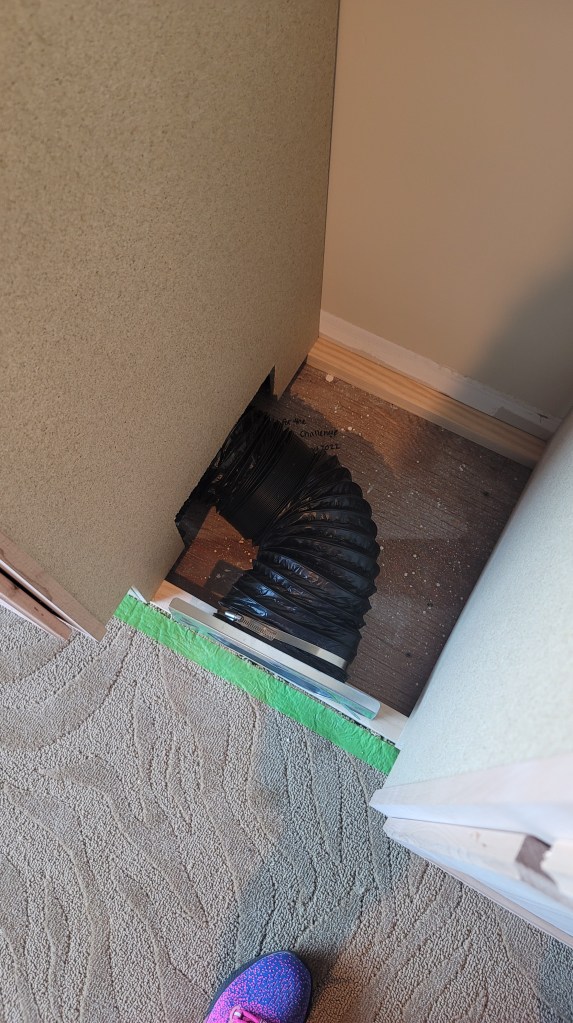
Once all the other cabinets were in, I was able to start working on the middle cabinet. The middle cabinet was going to need a large hole cut in the bottom on the left side to allow for the vent ducting, and I was going to have to attach the other end of the vent to the toe-kick section of the cabinet. That meant cutting a large hole in the front of the toe-kick as well.
While the cuts aren’t perfect (still working on my jigsaw skills!), the vent fit perfectly, and I was able to get the cabinet in place with 1/16″ to spare on each side.
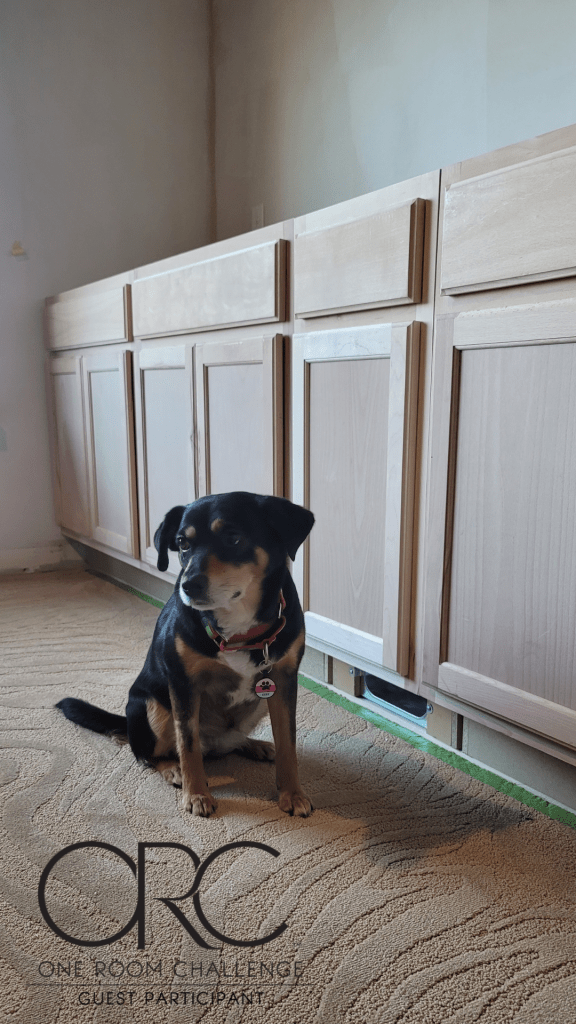
I was pretty proud of myself for getting the venting figured out and the cabinets in place. I tested a piece of baseboard, and it’s a perfect fit.
Lilly was pretty impressed, too.
Once everything was in place, and I was able to confirm the cabinets were level and even, I then secured them to each other using 0.5″ scrap pieces between the cabinets, as well as securing them to the studs in the wall. Those cabinets aren’t going anywhere!
Looking ahead to next week
Even though there’s a lot left on my to-do list, getting the skeleton of the bench and the cabinets completed was a huge step (and a huge relief!) forward. Looks like I’ll have to enlist Blake’s help when it comes to cutting the plywood and building the shelves because that plywood isn’t light!
I’m also hoping to get the finishing work done on the bench, along with getting the ceiling completed. It’s a lot to do, but I think I can get it done. Make sure you keep up with my Instagram stories. See you next week!
Here are the links to everything I used to move the floor vent:
I didn’t get anything done over last weekend because Blake and I flew to Atlanta to surprise my parents who are both celebrating a milestone birthday this year, and to see our sweet niece and nephews (and their awesome parents, of course). Amazing weekend spent with family!
Week 4 of the One Room Challenge didn’t feel productive, but looking back, I’m happy with the amount of progress I’ve made. Having to remove the popcorn ceiling myself threw a little wrench into the timeline, but I think I’ll be able to make up for it. Progress is progress…right?
Ceiling progress
Last week, I removed the popcorn ceiling. This week, I had to fill in some spots with joint compound, sand down some spots I missed, and got the ceiling primed!
Even with just the primer on the ceiling, I’m extremely happy with how the ceiling is turning out.
I ran into a bit of a snafu when it came to the blue paint. I’d decided to use the same dark blue I’d used in the dining room for 3 reasons:
I already have it (so it’s free)
It’s perfect for the ceiling I’m envisioning
It helps with continuity on our main level
As I started mixing it, I noticed it was lumpy. I continued to stir, but the lumps didn’t disappear. I decided to attempt using it anyway.
After a few swipes with the roller, it was apparent that it wasn’t a great idea, so I had to scrape off the chunky lumps and order a new gallon of paint (there went “free”) . I think I just didn’t seal it well enough, so…lesson learned!
I picked up new paint from Sherwin Williams on Friday during my lunch break, and then got one coat on the ceiling before we left for a quick turn at the cabin.
Priming, prepping and planning
In addition to the ceiling paint, I got tape on the walls to mark the line of where the blue ends on the wall. I also got the walls primed to start with a fresh slate.
Once the electrical is done (more below), I can start with the cabinets and moving the floor vent and making it a toe-kick vent. I got that measured out and have a plan for getting that in place.
Planned progress…
This week should be a bit more productive! I have an electrician coming tomorrow to install a new light (like legitimately cutting into the ceiling, splicing some wires, and connecting a new feature) and hopefully a couple of new outlets.
Once that’s done (and as long as the weather is nice), I can get started on the built-ins…finally!
Make sure you’re following along in my stories on Instagram to see how this week goes.
If only there was a spell that could remove the popcorn ceilings in my new office…
Unfortunately, that’s not the case.
For week 3 of the Spring ORC, I decided to tackle the ceiling. There are a few reasons for this:
It’s messy.
It’s time-consuming.
It’s messy.
Before I get started on anything else, I really need to get the ceiling done. When you paint a room, you’re always supposed to start with the ceiling first, so that’s what we’re doing here.
Instead of letting my inner procrastinator take over this task, I decided to dive right in.
Preparation is important
Knowing that I’d be taking on the popcorn ceiling removal myself (without magic), I pulled open my favorite app (Amazon) and started looking for tools I’d need. There are two that I’m trying out:
In addition to the main ceiling scrapers, I also got a smaller set of scrapers (Amazon affiliate link) that were super helpful when it came to scraping close to the edges, along with a garden sprayer (Amazon affiliate link) to spray the ceiling with hot water.
I already had drop cloths to protect the floor and thick plastic to protect the walls, so no extra expenses there!
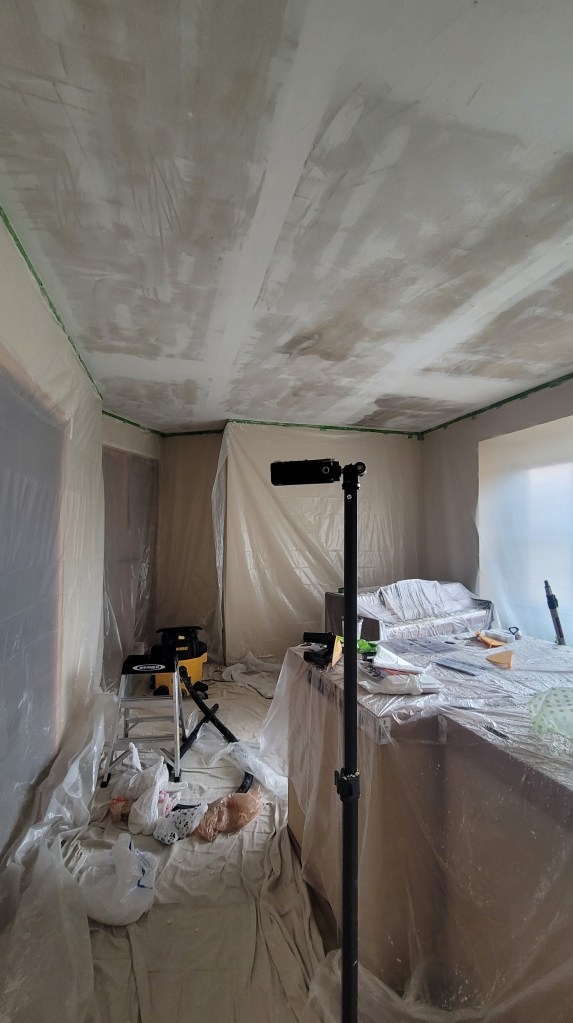
Since we’re spraying the ceiling with water, it’s important to protect the walls, no matter what. I taped plastic along the wall where it meets the ceiling and covered the entire room. I covered this process on Instagram, but here’s a quick view of how that looked.
A few tips:
Put tape on the back of the plastic first to help hold it in place.
Tape as close to the ceiling as you possibly can.
If you can, have someone help you.
It took me about 2 hours to get the plastic sheeting up on every wall, but it was well worth the time spent. I didn’t have to worry about the walls at all, and they stayed dry during the process.
Next up: Aguamenti
Once the walls were protected, I spread a drop cloth down in one corner. My thought was I could finish laying drop cloths while the water was soaking into the ceiling. (Work smarter—not harder.)
So, I pulled out my wand and cast the Aguamenti spell to start wetting the ceiling. Not really. But the sprayer looks sort of like a wand.
[Aguamenti is the spell for water.]
After all the research I did, I read that using hot water was key. So that’s what I did.
I started out small and just did a 2 ft. by 2 ft. square to see how the ceiling would accept the water. I let it soak for 10 minutes, then sprayed one more time and let it sit for 5 minutes.
I would actually recommend spraying a whole strip of the ceiling (about 3-4 feet wide) at a time. It will help you get through scraping much more quickly. As a frame of reference, the first day I worked on the ceiling, I spent about 2 hours scraping half the ceiling. On the second day (spraying larger sections), it only took me an hour to finish the other half of the room.
A few tips:
What goes up must come down, so make sure you’re wearing eye protection. And maybe a poncho.
Spray in larger sections and let the water soak in for at least 10 minutes.
Wear shoes. Nothing worse than stepping on a wet drop cloth in your socks.
Next step: Scourgify
Now came my nemesis: the popcorn. I was convinced part was going to take hours upon hours.
Using the Scourgify spell didn’t work, unfortunately.
[Scourgify is a charm used to clean.]
You’ll see how I struggled in the beginning. I even slowed the video so you could fully encompass the struggle.
While I had a rough start, once I got into a rhythm, scraping the ceiling was pretty quick and easy. Keep in mind that I tried two different tools. A manual scraper with a grocery bag attached (link above) and a scraper that attaches to my shop vac.
I posted a poll on Instagram asking which tool people thought would be more successful. An overwhelming 90% of you guessed the manual scraper.
And you were RIGHT!
The one that attaches to the shop vac doesn’t get my vote at all. I thought it would be great because it would suck up all the popcorn, but the “blade” was plastic and just wasn’t getting close enough to the drywall to be effective.
Lots of tips:
Use a grocery bag with the manual scraper and change it out once it gets heavy.
Unless you’re an expert with an extension rod (I was not), skip it and just climb up and down a ladder.
Take your time to avoid gouges.
Wear eye protection, a mask and, for those with long hair, a shower cap.
Expect to feel popcorn fall down your shirt and for everything to be covered in popcorn and whatever popcorn is made out of (joint compound), including your ladder.
Use the smaller scrapers to carefully go over sections that don’t seem to budge with the large scraper, as well as for next to the wall. It’ll be messy, but they’re a lifesaver.
The almost-final result
All in all, it took me about 3 hours total to remove the popcorn ceiling. There are a few places I’ll need to touch up and/or sand down, but that should be relatively easy.
If you’re not sure that you can do this yourself, you absolutely can. All it takes are the right tools, the right preparation, hot water and some patience. Seriously. I’d never done this before, which is why I was going to outsource it, but once we got the quote for it, I couldn’t justify spending a large amount of money on something like this.
Now that the popcorn is removed, I can touch up a few spots, clean the ceiling and prime, and then get started on the fun stuff.
Don’t forget to follow along in my Instagram stories for more real-time shenanigans.
If you have questions about any of the process, feel free to leave them in the comments. I’ll also post a question box on Instagram.
It’s somehow week two of the Spring One Room Challenge (sponsored by Apartment Therapy), and I’m starting to feel a little more confident with how the room is going to come together (eventually).
I didn’t get as much accomplished in the last week as I’d hoped I would, but for good reason—my puppies wanted a lot of snuggle time, and I wanted to embrace that. Plus, I’m a perpetual procrastinator.
So…what did I get done?
While I didn’t get everything done that I was planning, I was still able to accomplish a good bit:
Brought in the base cabinets with the free labor of my husband’s buddies
Removed all the baseboards, window trim and trim around the french doors
Measured and cut out a strip of carpet for where the base cabinets will go
Planned out a bench for the dogs
Planned out the future fireplace
Got a quote for removing the popcorn ceiling
Ordered tools to remove the popcorn ceiling myself
Ordered lumber for the bench and fireplace builds
When I look at this list, I feel pretty good about what I got done within a week. I’m much further along this time than I was for the Fall ORC. Still have a ways to go, but we’re getting there.
The curse of the trim
One of the biggest updates I’ve made to rooms in this house to take it from 1989 wooden blah to modern beauty is replacing the trim and baseboards, one room at a time. I love a clean, white trim. Nothing fancy. I’m pretty sure that the trim currently in the house is original to the house and is all stained wood. Not really my style. (No shade to those of you who like wood trim!)
Usually, replacing trim is an easy and relatively inexpensive update to a room. So when I saw “remove trim” on my to-do list, I figured I’d be done within an hour and ready to move on to the next project.
Boy, was I wrong.
This house throws new curveballs at me every single time I work on a new room. The only issue I had in the great room during the Fall ORC was one baseboard that had been screwed in at one corner. That was a nice surprise.
This time around, I really struggled to remove the trim in my new office space. It took me about 10 minutes to remove a four-foot section of the baseboard. That’s not normal. Usually, they come out pretty easily. And since these baseboards are stained, there’s no caulk to contend with.
Turns out that in addition to brad nails, these baseboards were installed old-school style—with 2-inch long nails. You’d think these baseboards were holding up the house. (Side note: If you hear about a house collapsing in Minnesota, come check on me.)
It took me a few hours to remove all the trim in this room. Not normal. But I got all the trim removed, minus the door trim around the double pocket doors (I’ll tackle that this week), and safely transported to the garage, where they will probably sit until the end of time.
Once the trim was removed, I could move on to the carpet. Oh, the carpet.
Confidence to cut the carpet
The biggest roadblock to the built-in cabinets and bookshelves was cutting the carpet. Build cabinets with bookshelves? No problem. All the confidence in the world to build something I’ve never attempted before. Cutting out carpet? I had to work up the courage for that.
Had it not been for what I’ve seen on Instagram, I would’ve just built the cabinets right on top of the carpet. Luckily, I follow so many amazing creators that I learned before I even planned this out that building on top of carpet is a no-no.
Why was I worried about cutting the carpet? It’s one of those things you really don’t want to mess up. I know I mentioned in my room tour on Instagram last week (check it out in my Spring ORC highlight bubble) that I’m not a huge fan of the golden/tan zebra/tiger print carpet, but won’t be replacing it right now.
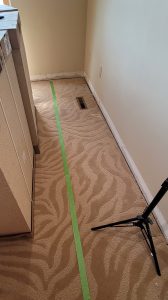
I measured a base cabinet, measured it again, measured it to confirm for the third time, and then marked the measurements on each wall. Then I took my handy FrogTape (not sponsored) and placed tape (measuring every foot or so) all along where my cut would be. Once I had everything taped out, I grabbed my knife and a level (something to guide the knife against) and decided that I wasn’t ready.
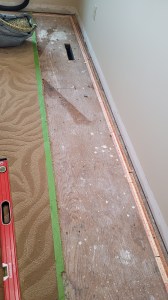
I did that for about four hours until I finally just bit the bullet and started cutting. While the carpet was really thick, I had it pulled up in minutes. The padding was easily removed as well, and the subfloor looked great. Sometimes you just have to build up the confidence and go for something that makes you nervous. For me, it was cutting the carpet.
Minus a snafu at the bottom, relatively easy to cut out a strip of carpet!
Now, all that’s left is removing staples and the tack strip before I can build my base for the base cabinets to sit on. That should happen over this next week.
Planning for new builds
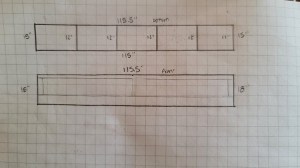
I decided that since the dogs and I spend about eight hours a day in my office, that I really did need to consider building them a bench so they could earn their keep by being watchdogs. In order to do this, I measured a standalone bench I have in my current office for the depth and height (15″ deep and 20″ high, including the cushion) and mimicked that in my new office.
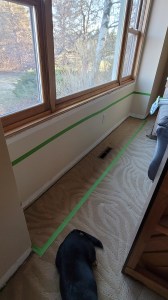
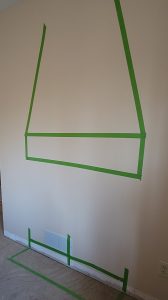
The window wall juts out about 12″, so the 15″ depth looks fine. I was concerned it would be super noticeable, but the depth will be perfect and will look as if it was always supposed to be there (I hope). As a visual, I used more FrogTape to plot out the depth and height. If you don’t do this and are a visual person, it’s so helpful.
Taping out the bench on the wall/carpet to get a good visual.
Rough sketch of what the bench will look like and where the supports will go.
Once I had the bench figured out (easy since it’s essentially a big rectangle), I moved on to how I would create a fireplace. I started with tape on the middle of the wall opposite of where the built-in cabinets would be. It just looked weird. So I threw that idea out the window.
See? Weird.
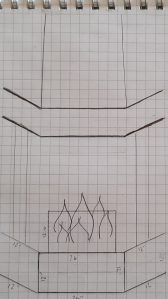
I measured out how much space I had in the corner and decided that a corner fireplace was just the ticket. I scored a great lightning deal on Amazon for this electric fireplace,* so I knew it was kismet. Reminds me of when we see Sirius Black in the Gryffindor common room. I used graph paper to plot out what the fireplace could look like and then drew out what it would look like from the front.
I am in no way, shape or form any sort of artist. But I’m good with a ruler.
With everything on graph paper, I was able to easily calculate how much lumber I would need, including plywood. Home Depot makes it easy with online ordering and curbside pickup, so I placed an order today and get to pick everything up after work.
The death of popcorn is to come
One last major to-do I completed this past week was getting a quote on popcorn ceiling removal. Knowing that removing a popcorn ceiling could be on the pricey side, I braced myself but had a number in mind for this size room. The quote I received was more than twice the number I had in my head (based on the research I found that contractors typically charge about $2 a square foot for removal), and about five times the amount based on the research I’d done.
I laughed before I realized I would have to take this on myself. So, I spent about $80 on supplies via Amazon and will get started with that tedious task myself. Only thing it’s going to cost me is time and my sanity.
*This item is an Amazon affiliate link. What that means is that if you click on a link I provide and buy an item, I get a few pennies. There is no cost to you whatsoever.






 Frels at HoMN